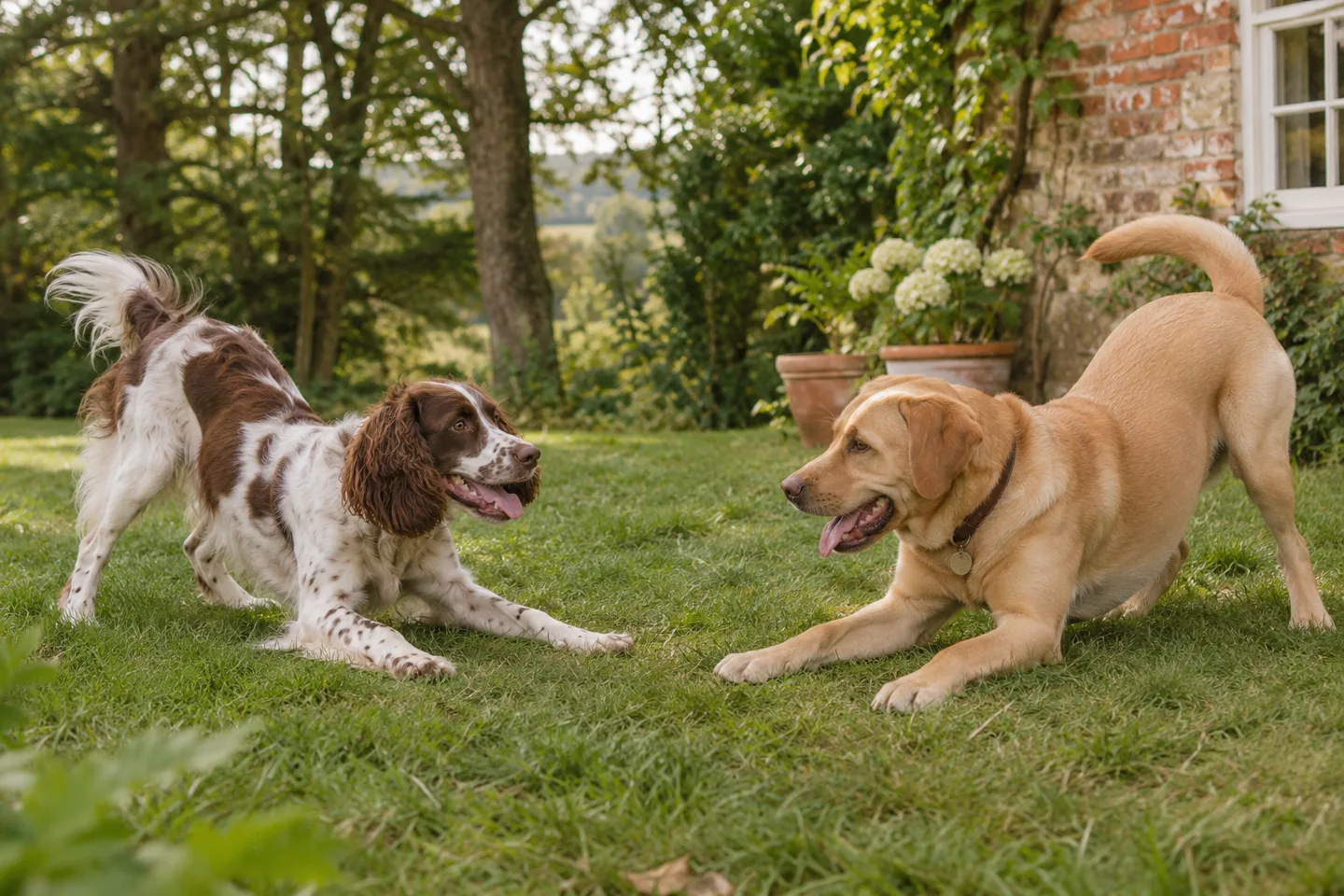
Watch the whole conversation
Look at each dog’s posture, movement, face, and available space. Then watch how the other dog responds. A moment that looks energetic may be comfortable for both dogs, or it may show one dog trying to escape. Context includes size differences, familiarity, surroundings, fatigue, and whether either dog can leave.
Avoid diagnosing emotion from a still photograph. A wagging tail does not automatically mean friendliness, and growling can occur in different contexts. If you cannot read the interaction confidently, create space and ask a qualified professional for guidance. The goal is to make good management decisions, not to prove an interpretation correct.
Look for flexibility and room to pause
Relaxed play often contains curved or bouncy movement, changes in pace, and pauses. A dog may lower the front of the body in a play bow, but watch what follows. Does the other dog choose to approach, or do they turn away? An invitation is only useful if the recipient can decline.
Roles may change as dogs chase or wrestle, but play does not need to be perfectly symmetrical every second. Look for an overall pattern of willing participation. A larger dog reducing intensity can help an interaction work, while repeated overwhelming contact suggests the pairing or activity needs adjustment.
Notice the dog who is leaving
Pay attention when a dog moves behind a person, heads toward a gate, turns away, or repeatedly tries to increase distance. Those actions should not be dismissed because the other dog wants to continue. Give the withdrawing dog space and prevent pursuit. Do not hold them in place for another greeting.
Some dogs pause briefly and return willingly; others need the interaction to end. Watch the pattern rather than treating one movement as a universal rule. If the environment makes escape difficult, change the setup. A room with no useful exit can turn a tolerable interaction into one the dog cannot manage.
A practical pause check
| What you notice | Useful response |
|---|---|
| Both dogs pause and approach again comfortably | Continue watching with room for breaks |
| One dog repeatedly hides or moves away | Prevent pursuit and offer distance |
| Stiffness or intensity is increasing | End the interaction using a safe procedure |
| You cannot read the situation confidently | Create space and ask for qualified help |
Use breaks before intensity becomes a problem
Call dogs away using familiar cues if they can respond, or follow the provider’s practiced safe separation procedure. Reduce stimulation and give them distance. Do not wait for a dramatic incident to justify a pause. Breaks can reveal whether both dogs choose to return to a calmer interaction.
Avoid reaching between unfamiliar dogs or grabbing collars during escalating conflict. Keep children away and seek professional guidance about safe management. If a fight or injury occurs, contact the appropriate veterinary service and follow a safe plan for separation. Online body-language guidance cannot replace hands-on emergency help.
Match more than body size
Size can affect physical safety, but energy, style, confidence, and ability to pause also matter. A quiet large dog may find a persistent small dog difficult, and two equally sized dogs may have incompatible play preferences. Observe the actual partnership rather than relying on breed stereotypes or a label such as “friendly.”
Introduce dogs thoughtfully in an appropriate setting with capable supervision. Avoid adding valuable food or toys if that could create competition. Keep the initial interaction manageable and stop if either dog is struggling. In daycare, ask how staff reassess matches as dogs become tired or groups change.
Tell caregivers what you saw
Use specific descriptions: “He went behind the bench three times while the other dog followed” gives staff a clearer starting point than “They looked weird.” Note the context, what happened immediately before, and whether the dog could recover after a break. A short factual account supports a useful discussion.
Ask what the caregiver noticed and what they changed. If their only explanation is that dogs must establish dominance or work it out themselves, ask further questions about supervision and welfare. You can choose a different setup if the response does not address your dog’s comfort or safety.
Example: the game that becomes one-sided
Two dogs begin with loose movement and brief chases. After several minutes, one repeatedly turns toward the gate while the other follows closely. The earlier friendly moments do not erase the new pattern. Create a safe pause, give the withdrawing dog space, and prevent the pursuit from continuing.
After both dogs have had room to settle, consider whether the session should end. You do not need to restart just to test whether they can manage it. If play resumes, watch whether participation is voluntary and intensity remains suitable. A shorter successful interaction is a reasonable outcome.
This hypothetical scene illustrates changing consent and comfort rather than a fixed rule about chasing. The same visible action can have different meanings in another setting. Use the full pattern, your dog’s familiar behavior, and qualified guidance when needed. If safe separation is uncertain, seek help rather than placing your hands between dogs.
Make observation part of everyday care
Practice watching low-intensity moments: a greeting with a familiar friend, a pause on a walk, or a dog deciding whether to approach. You do not need to arrange rough play to learn. Repeated calm observation helps you recognize your own dog’s usual movements and notice changes more readily.
For background, use the RSPCA body-language resource linked below. For care decisions, combine those observations with our guide to daycare enjoyment and the daycare tour checklist. When behavior changes suddenly, or fear and aggression are persistent, involve your veterinarian and an appropriately qualified behavior professional.
Sources & further reading
Sources checked November 3, 2026. Practical examples are hypothetical planning scenarios. This article has not been individually reviewed by a veterinarian. Contact your veterinarian for health concerns or individual advice.